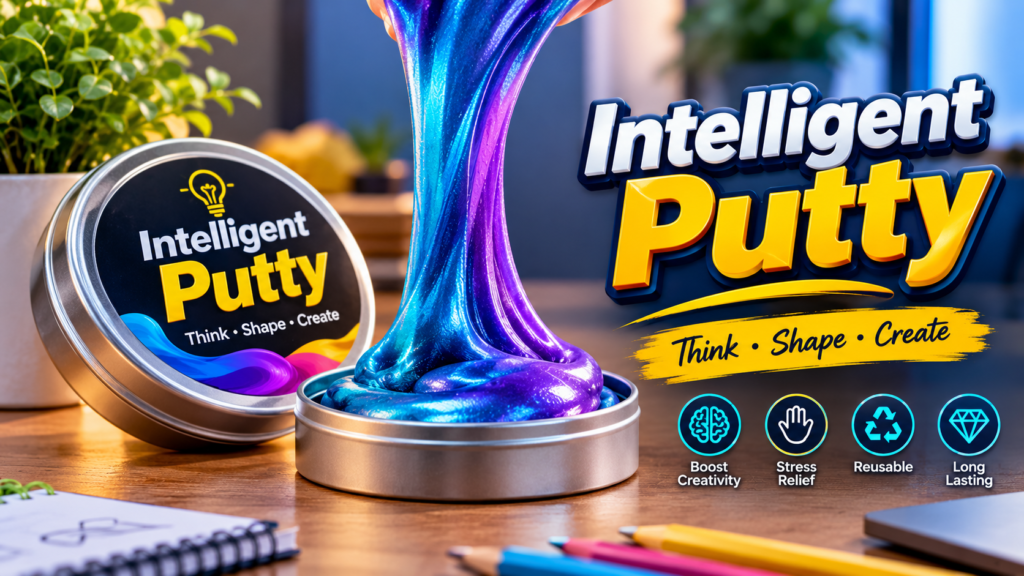
Intelligent Putty is a flexible sensory material that combines entertainment, creativity, and hands-on exploration. Unlike ordinary modeling clay, this type of putty can stretch, bounce, tear, twist, and change its appearance depending on its formulation. It is commonly associated with sensory play, stress relief, creative activities, and simple demonstrations of physical properties.
One well-known example is Crazy Aaron’s Thinking Putty, a product developed by Aaron Muderick. Although “Intelligent Putty” is often used as a descriptive keyword for advanced or interactive putty, it is important to distinguish the general concept from a specific registered product name. Thinking Putty is one established example of a specialty putty with unusual physical characteristics.
This guide explores Intelligent Putty, its background, properties, varieties, possible uses, benefits, care instructions, and safety considerations.
Quick Information Table
| Category | Information |
|---|---|
| Main keyword | Intelligent Putty |
| Product category | Sensory and creative toy |
| Common material | Silicone-based putty in products such as Thinking Putty |
| Main characteristics | Stretching, bouncing, pulling, twisting, and molding |
| Common uses | Sensory play, creative activities, relaxation, and demonstrations |
| Notable example | Crazy Aaron’s Thinking Putty |
| Available varieties | Magnetic, color-changing, glow-in-the-dark, glitter, scented, and other specialty types |
| Suitable age | Depends on the product and manufacturer’s instructions |
| Storage | Keep in its original container when not in use |
| Safety note | Not edible; small pieces and magnets may present hazards |
What Is Intelligent Putty?
Intelligent Putty is a general term used to describe specialty putty that responds to handling in interesting ways. Depending on its composition, it may stretch slowly, snap when pulled quickly, bounce when rolled into a ball, or hold a shape after being molded.
Its appeal comes from the way it behaves differently under different conditions. Some varieties are designed to change color with temperature, glow in darkness, react to magnets, or contain glitter and other visual effects.
Unlike traditional modeling clay, many silicone-based putties are designed to retain their flexibility rather than becoming permanently dry during ordinary use. This makes them suitable for repeated handling and experimentation.
The term Intelligent Putty does not necessarily identify one manufacturer or a single standardized formula. Product ingredients, physical properties, age recommendations, and safety instructions can differ between brands.
The Background of Modern Specialty Putty
One prominent name in the specialty putty market is Crazy Aaron’s Thinking Putty. Its development began with Aaron Muderick’s experiments in 1998. He explored the material’s unusual properties and worked on creating a putty that would provide an enjoyable experience beyond conventional desk toys.
The company’s history describes how the original concept developed into a dedicated product business. Its manufacturing process required particular attention because the material’s behavior depended on its formulation and production methods.
Crazy Aaron’s Puttyworld launched in 2001. The business initially sold its products online and later expanded into independent toy retailers and specialty shops.
Over time, the company developed numerous varieties with different textures, colors, visual effects, and sensory characteristics. This history helps explain why modern specialty putty is now associated with creative play, collecting, and sensory experiences.
Main Features of Intelligent Putty
The characteristics of Intelligent Putty depend on the specific formulation. However, several properties are commonly associated with specialty silicone putties.
1. Stretchable Texture
Stretchability is one of the most recognizable features. Users can pull and extend the material into long shapes, fold it, and combine it again.
The speed and force used during handling can affect how the putty responds. Some formulations stretch gradually, while others may separate when pulled quickly.
2. Bouncing Ability
Certain putties can be rolled into a ball and bounced against a suitable surface. This property makes them different from many traditional modeling materials.
Bouncing performance varies by formulation, shape, temperature, and surface. Not every specialty putty is designed to bounce.
3. Shape Retention
Intelligent Putty can often be molded into different forms. Users can create simple shapes, patterns, figures, and decorative designs.
Some varieties hold their shape for a period before gradually changing under their own weight. This makes the material useful for experimenting with form and movement.
4. Color-Changing Effects
Some specialty varieties respond to temperature changes by shifting color. These products can provide a simple way to explore how temperature affects materials.
The exact color response depends on the product. Users should follow the manufacturer’s instructions for achieving the intended effect.
5. Magnetic Properties
Magnetic putty contains magnetic material and can respond to an appropriate magnet. Depending on the formulation, it may move toward a magnet or form unusual shapes as the magnetic force affects it.
Magnetic versions require extra care because strong magnets can be dangerous if swallowed. They should be kept away from young children and handled according to the manufacturer’s age guidance.
6. Glow and Glitter Effects
Some varieties contain materials that create a glowing appearance in darkness or a sparkling effect under light. These features are mainly visual and make the putty attractive to collectors and people who enjoy creative activities.
7. Reusable Formulation
Many silicone-based putties are designed for repeated use and do not dry out in the same way as ordinary modeling clay. Proper storage helps preserve their texture and condition.
However, exposure to dust, fibres, oils, and other contaminants can affect the material.
Popular Types of Specialty Putty
Different formulations provide different experiences. The following types are commonly found in the specialty putty market.
Magnetic Putty
Magnetic putty responds to magnetic forces. It can be used for supervised demonstrations of attraction and movement.
It is important to remember that magnetic putty may contain strong magnets or magnetic components. Follow the product’s safety instructions carefully.
Color-Changing Putty
Color-changing putty reacts to temperature. Its appearance may shift when it becomes warmer or cooler.
This type is particularly interesting for people who enjoy visual effects and simple material experiments.
Glow-in-the-Dark Putty
Glow-in-the-dark varieties contain materials that produce visible light after exposure to a suitable light source. Their brightness and glow duration depend on the formulation and charging conditions.
Glitter Putty
Glitter putty contains decorative particles that create a sparkling appearance. It is mainly designed for visual appeal and creative handling.
Scented Putty
Some specialty putties include fragrances. These varieties combine tactile interaction with a scent-based sensory experience.
People with fragrance sensitivities should check product information before using scented versions.
Transparent or Liquid-Glass-Style Putty
Certain products are designed to look clear or glass-like. These formulations can behave differently from traditional elastic putty.
For example, Crazy Aaron’s Liquid Glass is a distinct product type. It is designed for transparency and does not behave exactly like ordinary Thinking Putty. It should not be assumed that every transparent putty has the same texture or performance.
Common Uses of Intelligent Putty
Intelligent Putty can be used in several everyday and recreational settings.
Sensory Play
The different textures and movements provide hands-on sensory experiences. Children and adults can explore stretching, squeezing, folding, and shaping the material.
The appropriate product and level of supervision depend on the user’s age and the manufacturer’s instructions.
Creative Activities
Putty can be shaped into small objects, patterns, and temporary designs. Users can experiment with different forms without needing complicated equipment.
It is generally best suited to temporary creations rather than projects that require a permanently hardened material.
Relaxation and Stress Relief
Some people enjoy squeezing, stretching, and manipulating putty as a simple tactile activity during breaks.
The repetitive movements may feel calming or provide a brief distraction. However, Intelligent Putty should not be presented as a medical treatment or a guaranteed solution for anxiety or stress.
Educational Demonstrations
Specialty putty can help demonstrate basic physical concepts, including elasticity, deformation, temperature response, and magnetic attraction.
Teachers and parents can use suitable varieties to introduce these ideas through supervised activities.
Desk and Recreational Use
Small containers of putty are often used as desk toys. They offer a hands-on activity during free time or breaks.
Users should keep the material away from keyboards, fabrics, carpets, and surfaces where it may collect dirt or leave unwanted residue.
Potential Benefits of Intelligent Putty
The value of Intelligent Putty depends on how it is used. Its main advantages are related to hands-on interaction and creative exploration.
- Encourages creativity: Users can experiment with shapes, patterns, and designs.
- Provides tactile engagement: Stretching and molding offer a direct hands-on experience.
- Supports exploration: Different formulations allow users to observe how materials respond to force, temperature, and magnets.
- Offers recreational variety: Different colors, textures, and effects provide several ways to interact with the material.
- Can be reused: Many silicone-based varieties are designed for repeated handling when properly maintained.
- Requires little equipment: Most ordinary activities can be performed using the putty and a clean working surface.
These are general recreational and educational advantages, not guaranteed developmental or therapeutic outcomes.
How to Use Intelligent Putty
Using specialty putty is usually straightforward, but a few basic practices can improve the experience.
- Wash and dry your hands before handling the material.
- Remove a suitable amount of putty from its container.
- Stretch it slowly to explore its flexibility.
- Fold and squeeze it to observe how it changes shape.
- Roll it into a ball if the product is designed to bounce.
- Try shaping it into simple objects or patterns.
- Return the putty to its original container after use.
For magnetic, temperature-sensitive, or other specialty versions, follow the instructions supplied with the product. Avoid experimenting with magnets or temperature extremes unless the manufacturer specifically permits the activity.
How to Store and Maintain Intelligent Putty
Proper storage is important because putty can collect unwanted material during use.
Use the Original Container
Keep the putty in its original tin or container when it is not being used. This helps protect it from dust and other environmental contaminants.
Keep Hands Clean
Dirt, natural skin oils, lotions, and other substances can affect the material. Clean, dry hands help maintain its condition.
Avoid Fabrics and Carpets
Putty can collect fibres and become difficult to clean if it comes into contact with clothing, carpets, or upholstered furniture.
Protect It From Contamination
Keep the material away from food, liquids, dust, and dirty surfaces. Once fibres or debris become embedded, it may be difficult or impossible to restore the putty to its original condition.
Pay Attention to Temperature
Some putties respond to temperature changes. If a product feels unusually sticky, the manufacturer may recommend allowing it to return to room temperature or using a specific care method. Always follow the instructions for that particular variety.
Safety Considerations
Although some specialty putties are marketed as non-toxic, that does not mean they are edible or suitable for every age group.
Crazy Aaron’s manufacturer information describes Thinking Putty as non-toxic and provides product-specific safety guidance. The company also notes that its manufacturing facility is not food-grade, so it cannot guarantee that products are free from every possible cross-contamination risk.
Important precautions include:
- Do not eat or swallow putty.
- Keep it away from children under three years old because small pieces may present a choking hazard.
- Supervise young children during play.
- Follow the recommended age range on the product packaging.
- Take additional care with magnetic varieties.
- Keep strong magnets away from small children and anyone who may swallow them.
- Stop using a product if its packaging or material appears damaged or contaminated.
- Wash hands after handling if recommended by the manufacturer.
Swallowing multiple strong magnets can cause serious internal injuries. If a magnet or magnetic component is swallowed, seek urgent medical attention.
Intelligent Putty Compared With Traditional Modeling Clay
Although both materials can be shaped by hand, specialty putty and traditional modeling clay are not identical.
| Feature | Specialty Putty | Traditional Modeling Clay |
|---|---|---|
| Stretching | Often highly stretchable | Depends on the clay |
| Bouncing | Some varieties can bounce | Usually does not bounce |
| Texture | Often flexible and elastic | Often firmer or more moldable |
| Shape retention | May slowly change shape | Often holds a molded shape |
| Special effects | May include magnetic, color-changing, or glow effects | Usually focused on shaping and modeling |
| Drying behavior | Many silicone varieties are designed not to dry out | Some types air-dry or require baking |
| Main purpose | Sensory play and interactive handling | Modeling and craft activities |
The best choice depends on the intended activity. Specialty putty is generally more suitable for interactive handling, while traditional modeling clay may be better for projects that require more stable shapes.
What to Consider Before Buying Intelligent Putty
Before purchasing a specialty putty product, consider the following factors:
Material and formulation: Check what the product is made from and whether it matches your intended use.
Age recommendation: Follow the manufacturer’s minimum age guidance and safety warnings.
Texture: Some varieties are designed to stretch, while others emphasize transparency, magnetic movement, or visual effects.
Special features: Decide whether you want a basic putty or a variety with glitter, fragrance, color-changing properties, or magnetic components.
Storage requirements: Check whether the product comes with a suitable container and how it should be maintained.
Manufacturer information: Review product descriptions, care instructions, and safety details rather than relying only on promotional claims.
Frequently Asked Questions
1. What is Intelligent Putty?
Intelligent Putty is a general descriptive term for specialty putty that offers interactive physical properties, such as stretching, bouncing, molding, or responding to temperature and magnets.
2. Is Intelligent Putty the same as Thinking Putty?
Not necessarily. Intelligent Putty is a broad descriptive phrase, while Thinking Putty is a specific product line associated with Crazy Aaron’s.
3. Is Intelligent Putty reusable?
Many silicone-based putties are designed for repeated use and do not dry out during ordinary handling. Their condition can still deteriorate if they become contaminated or are not stored properly.
4. Can Intelligent Putty bounce?
Some varieties can bounce when rolled into a ball. This feature depends on the product’s formulation, so not every type of putty will behave in the same way.
5. Does Intelligent Putty change color?
Certain specialty varieties are designed to change color in response to temperature. Other varieties maintain a consistent appearance.
6. Is Intelligent Putty safe for children?
Safety depends on the specific product and the child’s age. Always read the packaging, follow age recommendations, and supervise young children. Putty should never be swallowed.
7. Can Intelligent Putty help with stress?
Some people enjoy manipulating putty as a relaxing recreational activity. However, it is not a medical treatment and should not be considered a replacement for professional support when needed.
8. How should Intelligent Putty be stored?
Store it in its original container, keep it away from dirt and fibres, and use clean, dry hands when handling it.
9. Does all Intelligent Putty contain silicone?
No. Formulations can vary between manufacturers and products. Check the product description or packaging for accurate ingredient information.
10. What makes magnetic putty different?
Magnetic putty contains magnetic material that responds to an appropriate magnet. It requires additional precautions because swallowing magnets can cause serious injuries.
Why Intelligent Putty Remains Interesting
Intelligent Putty brings together simple hands-on play and unusual material properties. Its ability to stretch, change shape, and appear different across specialized formulations makes it more interactive than many ordinary modeling materials.
Products such as Crazy Aaron’s Thinking Putty demonstrate how a simple material can develop into a broad range of creative and sensory products. Different varieties offer different experiences, from magnetic movement and color changes to glitter, fragrance, and transparent effects.
For anyone exploring Intelligent Putty, the most important considerations are understanding the product’s actual formulation, choosing a suitable variety, following safety instructions, and storing it correctly. With realistic expectations and responsible use, specialty putty can provide an enjoyable activity for creative exploration and everyday recreation.
FuturesBrief.co.uk